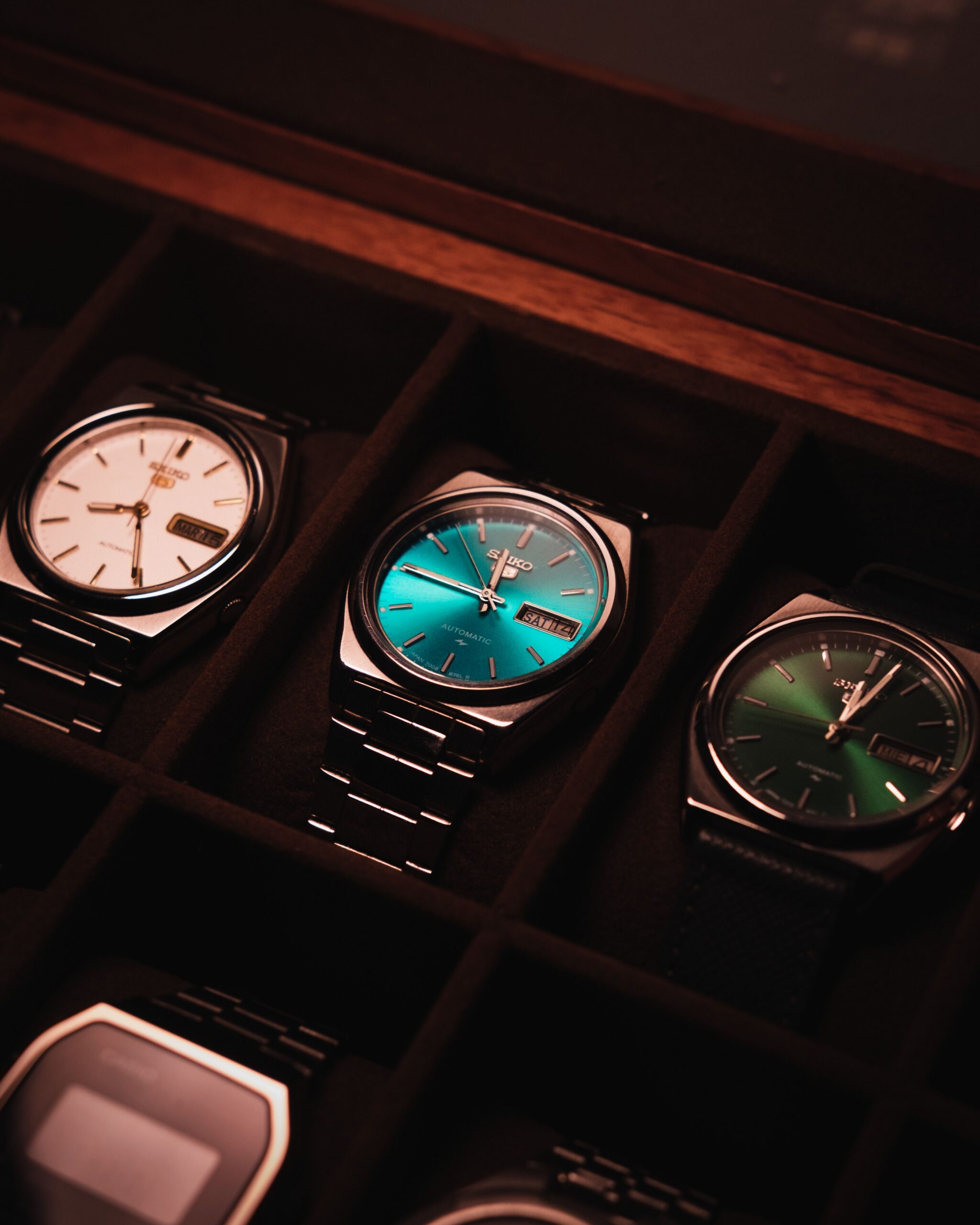
A good vintage watch is one of the most satisfying things you can own: a small machine, often decades old, still keeping time on your wrist. It also rewards a little homework before you buy. This guide covers what we look at ourselves when a watch comes in, so you know what to check and what to ask.
Manual, automatic or quartz?
Start with how you will wear it. A manual-wind watch needs winding by hand, usually once a day, and many owners enjoy that small ritual. An automatic winds itself from the movement of your wrist, so it keeps running as long as you wear it regularly. A quartz watch runs on a battery, keeps very accurate time and needs little more than a new battery every few years. None is better than the others; they simply suit different habits.
Size and fit
Vintage watches are often smaller than modern ones. Many men’s watches from the 1950s to the 1970s measure around 33–36mm across, which can look elegant and wears comfortably under a cuff. Check the case diameter in the listing, and the lug-to-lug length too, as that decides how the watch sits on your wrist.
What to check on the dial and hands
The dial is the face of the watch and has the biggest effect on value. Look closely at the photographs:
- Original or refinished? Some dials have been repainted over the years. A refinished dial can look very clean but is usually worth less to collectors. Crisp, even printing and a natural, gentle ageing are good signs.
- Lume. Luminous paint on the hands and markers ages over time. Matching colour on hands and dial suggests they have aged together.
- Marks and moisture. Spots or staining can point to past moisture getting in.
The case, crystal and crown
Look at the edges of the case and the lugs. Sharp, defined edges suggest little polishing; very soft, rounded edges suggest heavy polishing over the years. Check the crystal (the glass) for chips and deep scratches; many vintage watches use acrylic, which can often be polished or replaced easily. Make sure the crown winds and sets the time smoothly, and ask whether it is original to the watch.
Bracelet or strap
An original bracelet adds value, especially on sought-after models. Metal bracelets stretch with age, so look for gaps between the links. A replacement leather strap is perfectly normal and nothing to worry about.
Servicing and water resistance
Mechanical watches benefit from a service every few years, when the movement is cleaned, oiled and adjusted. Ask when a watch was last serviced and whether it keeps good time. Treat any vintage watch as not water resistant, whatever the dial says: seals age, so keep it away from the bath, the pool and heavy rain.
Questions to ask the seller
- Does it run, and how well does it keep time?
- When was it last serviced, if known?
- Are the dial, hands, crown and bracelet original?
- Can you send photos of the movement or the case back, or a short video of it running?
A seller who knows the watch will be happy to answer. If the answers are vague, take that as your cue to look elsewhere.
Our watches
Every watch we sell is genuine, tested and fully working. We describe condition plainly on each listing, including any wear, and we are always happy to send extra photos or a video before you buy.
Browse our tested vintage watches →